The Leadership of Terry Peters
“Be a person worth being around. Just be someone worth following. That’s the only secret to leadership.” – Special Forces Lieutenant Colonel Mike Salazar.
Every once in a while, you meet someone who quietly, powerfully shifts the way you think about leadership. Someone who doesn’t need a stage, who doesn’t lead through noise or ego—but by presence, humility, and an unshakable sense of purpose. I’ve only met a few people like that in my life. One of them—and one of the most impactful—is a man named Terry Peters.
It was 2009. I was a young Special Forces Intelligence Sergeant on an A-Team, still swimming in the deep end of my own ego. Back then, I had a default belief that I was smarter than most of my senior leaders. I figured if I were in their shoes, I’d do it better. That confidence—arrogance—is standard issue among most young Green Berets.
Terry Peters was the Group Command Sergeant Major—our highest enlisted leader. I’d met him in passing before, but this was the first time I had to brief him directly. I expected the usual: a few generic comments about Army Values, some carefully placed buzzwords, and a checklist of uninspired guidance. Instead, what I got was something entirely different.

He listened—really listened. His questions weren’t traps or ego tests. They were thoughtful, deeply informed, and genuinely curious. He wasn’t just trying to assess our readiness for deployment to Afghanistan—he was helping us think deeper and sharper about our own plans. He praised the work, asked how he could help, and told us—without a hint of performance—that the command team had our backs.
A week later, he saw me in the hallway. He stopped, asked more questions, and reminded me that his offer of support wasn’t just polite lip service. He meant it.
That interaction redefined what I thought leadership was supposed to look like. Terry wasn’t loud. He wasn’t self-congratulatory. He just gave a damn—and people felt it. He ingested more information than he transmitted.
Since retiring from the Army in 2010, Terry has continued to live out that same ethos. He has become a force of nature—respected, emulated, and trusted by everyone who’s had the privilege of knowing him.
After retiring, Terry didn’t fade quietly into the background—he built something. He founded a company called Leader Solutions and Decision Support (LSDS), which has since become a powerhouse, recently celebrating its 14th anniversary. What makes that even more impressive is that Terry did it without an MBA, with only a year of prior business experience, and without the traditional credentials people tend to think you need to succeed. He was just a country kid from a small town, driven by the same values he lived by in uniform: service, humility, and relentless excellence.

LSDS’s purpose is to enable people and organizations to excel and overcome adversity. Their mission is to equip individuals and organizations with the skills, tools, and support to realize their professional vision and deal with the consistent and emerging risks to people, mission, strategy, and brand. A mission Terry was very experienced with from his experiences accrued worldwide as a Green Beret.
Like many others who’ve crossed paths with him, I’ve spent years trying to figure out how to lead more like Terry. Eventually, I decided the best way to do that was to sit down with him—ask the questions, listen deeply, and learn. That’s exactly what I did.
What follows is part one of a multi-part series drawn from that conversation. It’s not just about leadership—it’s about what happens when character becomes the foundation of everything you build.
BECOMING AN ENTREPRENEUR – THE ORIGINS OF LSDS
Entrepreneurship gets romanticized a lot—like it’s all freedom, coffee shops, and motivational quotes. But in reality, it’s brutal. I’ve yet to meet a single founder who didn’t say that the early years almost broke them. Terry is no exception. When we talked about his journey with LSDS, he was open about the challenges and generous with what he’s learned.
He started with a story from LSDS’s early days when people doubted him right out of the gate.
“We were working with an organization early on, and the executive who hired us said, ‘You’re the point person on this—what’s your master’s degree in?’ I told him, ‘I don’t have one.’ He replied, ‘Okay… so why should we listen to you?’”
“So I laid it out. I explained what we’d done, how we approached our work, and how committed we were to learning in real time. And that was it—he got it. It was never an issue again. I’ve never felt limited by the lack of a degree because I have a track record of performance, I don’t rest on my previous accomplishments, and I’ve never stopped learning.” That learning equates to about two books per month, endless professional development attendance, and harvesting best practices from every organization we come across.
Terry founded LSDS a year after retiring from the Army.
“Honestly, I didn’t plan well for retirement,” he told me. “I kind of winged it. That was fine until I realized the paycheck was about to stop.”
He took a short-term job with a defense contracting company but quickly realized he wanted something more. He wanted to build something of his own—something that aligned with his values and leveraged the leadership experience he’d gained as a Green Beret.

I started with a straight question: “LSDS has clearly been successful—but how hard was it to get here?”
“Brutal,” he said. “It’s been extremely difficult. And what’s made us successful are a few core operating principles—but we didn’t start with those. We learned we needed them the hard way. They came from mistakes. Some of them were painful and borderline catastrophic. But we learned. We adapted. We built systems. We made sure we never repeated the same failures, and we became a stronger company at a core level in the process.”
One of those very early, hard-earned lessons came from a major misstep—one that nearly derailed the company.
“We made a critical mistake on a big project,” Terry said. “We overcommitted financially. Poor planning, delegation without backstops, some bad calls, and we ended up burning far more resources than we should have. The project was a success from the client’s perspective—but internally, it was a mess. It took us years to recover. Our financials were wrecked. Our chief of staff wasn’t thrilled either.”
That experience could’ve ended the company. But instead, it became the catalyst for one of LSDS’s most important transformations. Instead of beating ourselves up, we used it as a tool for growth.
“Grit gets you started,” Terry told me, “but it won’t save you from your own blind spots. What does? A learning mindset. You have to build a culture where mistakes aren’t just survived—they’re studied, absorbed, and transformed into systems.”
That mindset—relentless learning and operational discipline—became part of LSDS’s DNA. The company’s core operating principles weren’t dreamed up in a strategy session. They were forged in the fire of failure.
“Those principles are why we’re still here today,” he said. “They came from pain. But they work. And we live by them. Failure and defeat are not the same things. You can fail quite a bit, and if you use those failures to learn, you can’t be defeated and become stronger because of them.”
HOW HUMILITY DRIVES HIGH PERFORMANCE
Nobody cares what you did yesterday. What are you bringing to the table today?
That mindset is baked into everything Terry Peters does.
“In both the military and business,” he told me, “Your past record and reputation might get you in the door—but the runway they give you is short. If you can’t learn fast and deliver results, you’ll find that although you were granted runway access, you’ll crash and burn after not gaining the ability to achieve flight.”
I asked, “Is that part of the learning culture you mentioned earlier?”
“It’s more than just culture,” he said. “It’s about humility. You have to recognize that you’re not the only one in the field. And you’re not going to stand out just by thinking you’re awesome. At LSDS, we treat every day like it’s our first day. We study our clients—how they talk, how they operate, what challenges they actually face. Then we ask: What do we bring to the table that actually helps solve those problems?”
Terry knows that on any given day, a client can cut ties. They don’t care how impressive your résumé is. They care whether or not you can help them. That’s it.
To do that, you have to approach every new engagement with urgency, humility, and the ability to absorb information at high speed. Confidence in your skills is essential—but so is the awareness that you probably don’t know enough yet.
That mindset is what allowed LSDS to recover from early missteps and ultimately thrive. Terry built a culture where people are expected to admit what they don’t know, learn fast, and deliver solutions that work. It’s a cycle they’ve embraced:
Initial ignorance → intense learning → competent execution.
Then repeat.
They’ve mastered operating in that space—and it’s exactly what sets LSDS apart. It’s not just their technical skills or experience. It’s the humility to know they need to earn it every single day. Humility combined with competence allows them to stay just shy of operating within the bandwidth of hubris, which has allowed for continual growth and success.
This concludes part one of a three-part series titled No MBA, No Ego, No Excuses. Part two will discuss embracing adversity, invisible friction, and the significance of company culture. Stay tuned and check out Terry and LSDS on LinkedIn here.
_________________________________________________________________

Terry Peters founded LSDS in 2011. As the Chief Executive Officer and leader of the Organizational Success programs, Terry has led LSDS to substantial yearly growth in all the company’s lines of effort. He spearheads leader development programs and executive coaching of leaders.
Prior to founding LSDS, Terry served as the General Manager of a large defense contractor, leading a 2000-person team. His 27 years in the US Army included four years in combat and deployment to dozens of countries while serving.
as an Infantry and Special Forces Noncommissioned Officer. He has led from the individual to large force level in some of the most demanding assignments and has numerous decorations and foreign awards for his service. Terry concluded a successful career as the Combined Joint Special Operations Task Force- Afghanistan Sr. Enlisted Leader, while dually serving as the 3rd Special Forces Group Command Sergeant Major. In this capacity, he was responsible for the training and readiness of over 6500 Marines, Soldiers, Airmen, and Sailors spread across Afghanistan, and another 1500 Special Forces Soldiers at home and abroad.
Terry serves as an advisor to several organizations and contributes a significant amount of time assisting Special Operators and their families through outreach, and by supporting numerous charities focused on warriors and their families.
_________________________________________________________________
About the Author
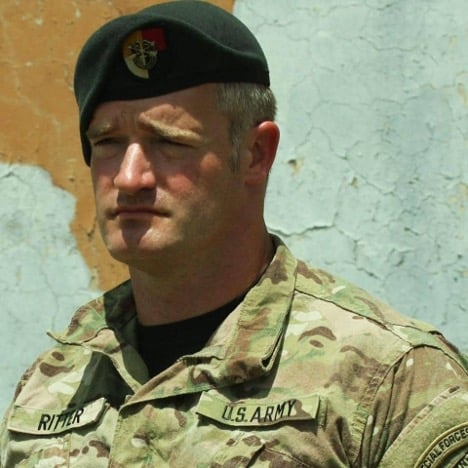
Chuck Ritter is a retiring Army Special Forces sergeant major stationed at Fort Bragg, NC. He will retire in June 2025. He is a co-founder of Objective Arete, LLC, a veteran-owned self-development company. Chuck previously co-hosted/produced the Pineland Underground Podcast and serves on the Board of Directors for the Dreams 4 All Foundation.
He has been awarded the Silver Star Medal, Bronze Star for Valor, Army Commendation Medal for Valor, three Purple Heart Medals, the Triple E Valor and Courage award, and most importantly, the NDSM and Air Assault Badge. He also awarded himself the Charles P. Ritter Award for being “pretty cool.”
He is attending Norwich University, completing a B.S. in Strategic Studies and Defense Analysis. He will continue a Master’s program in 2025.
_________________________________________________________________
Check out our Social Media and The Objective Podcast! This Linktree goes to all of our outlets.
Sign up for our newsletter to get updates on our latest articles, podcast episodes, events, and more on our Homepage!
You can learn more about Objective Arete and our Team Here.
We seek writers who want to share stories, lessons learned, and opinions that can help others. If you would like to publish with us, please email Ayman@objectivearete.com.
Live With Purpose, Embrace Adversity, and Relentlessly Pursue Excellence!
Buy Me A Coffee
If our words resonate, help us keep writing them.
The Arete Journal exists for those striving to grow—individuals committed to becoming stronger, wiser, and more impactful for their families, communities, and society. We don’t run ads in our journal. We don’t chase clicks. We rely entirely on the generosity of readers like you.
If our work has inspired you, challenged you, or helped you on your journey, consider supporting us. Every donation fuels the next insight, the next story, the next spark of growth.
Buy us a coffee (Small donation)—and help build a better future, one idea at a time.