
Fulcrum: “The point at which a bar, or something that is balancing, is supported or balances: A seesaw balances at its fulcrum.” – Cambridge English Dictionary
Mike Lerario, host of the Objective Arete Podcast, author, and mentor to the OA founders, uses the tagline “Be the Fulcrum.” He emphasizes that you need to be the fulcrum in life. You can’t rely on other people or situations to adjust to your way of doing business. Instead, you must continually evaluate your situation and surroundings and adapt to create balance.
Aristotle’s Theory of the Golden Mean explains the concept of finding balance in all things. Most issues in life arise when we operate in extremes. For instance, Aristotle defined the Virtue of Courage as balancing recklessness and cowardice.
Be the Fulcrum
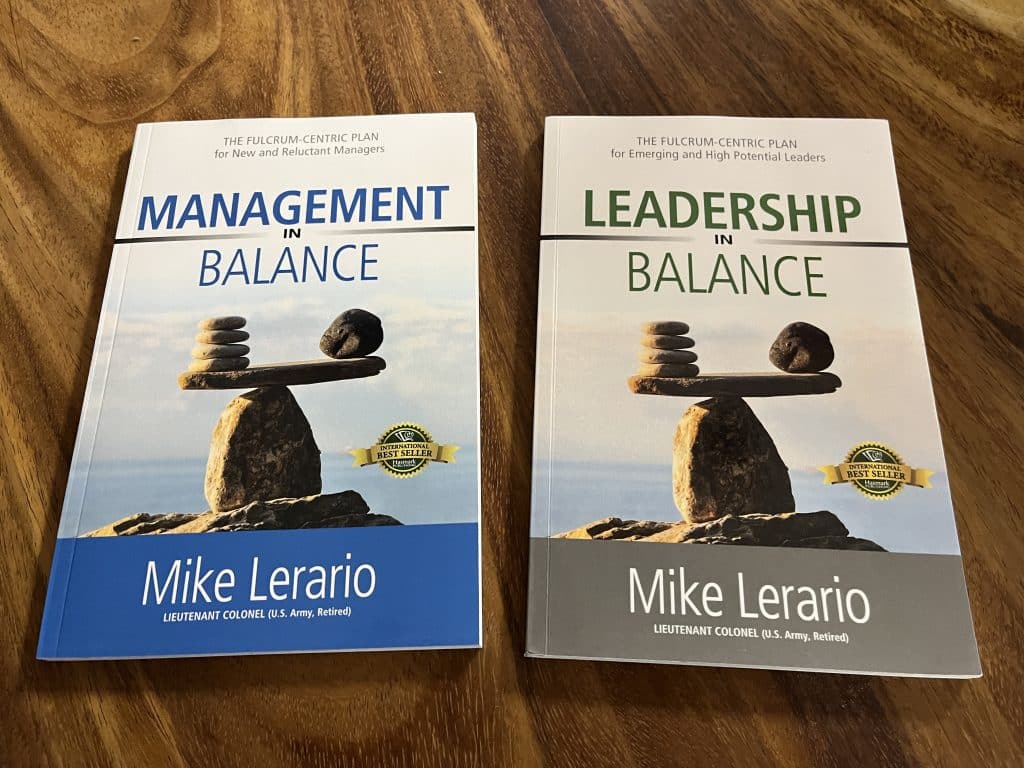
How can one “be the fulcrum?” Mike has defined his model in his books Leadership in Balance and Management in Balance. His model comprises four domains: Communications, Adaptability, Focus, and Influence. He breaks these into two tendencies on the extremes, which he calls exclusive and inclusive. He uses these terms because one side is purely internal, and the other requires outside entities.
- Communication: The extreme tendencies here are transmit and receive. These can be defined as the “talkers” and the “listeners.” Transmitting only requires you while receiving involves someone else.
- Adaptability: The extremes here are rigid and flexible. This would be “my way or the highway” and “being open to different options. One requires your innate genius and ability to reinvent the wheel, and the other requires you to be open to other possibilities.
- Focus: The extremes of focus are selfishness and selflessness. You can be focused entirely on yourself or entirely on others.
- Influence: The extremes here are command and control. Mike defines these as commands being more hands-off and control being more hands-on and controlling. This would be a micromanager vs someone who allows for decentralized initiative.
Mike’s model is just that—a model. He makes no claims of it being perfect, but modeling is generally important for making theoretical concepts actionable, which is his intent in creating the Fulcrum Centric Model.
The Fulcrum model doesn’t promote extreme or perfect balance at the center as ideal. Mike suggests that neither extreme is inherently negative. We must be aware of our personal tendencies, as we naturally gravitate toward one of the extremes. I know I tend to transmit more than I receive, which can sometimes be problematic. The solution isn’t to seek balance in the middle but to adjust where you need to shift, like a fulcrum, to balance the situation, requiring either more or less of an extreme based on different circumstances. Ultimately, Mike’s model emphasizes self-awareness and the ability to assess each situation to be adaptable and effective.
“What can I do?“
For further exploration, Check out Mike’s Website at www.bethefuclrum.com.
His books, Leadership in Balance and Management in Balance, are available on Amazon. They are very short and to the point, and I recommend them to all young, aspiring leaders.
We also recommend reading Aristotle’s Theory of the Golden Mean, which can be found online, rather than reading his books. It’s a great concept to consider and apply to your life.
Check out our Social Media and The Objective Podcast! This Linktree goes to all of our outlets.
Sign up for our newsletter to get updates on our latest articles, podcast episodes, events, and more on our Homepage!
You can learn more about Objective Arete and our Team Here.
We seek writers who want to share stories, lessons learned, and opinions that can help others. If you would like to publish with us, please email Ayman@objectivearete.com.
Live With Purpose, Embrace Adversity, and Relentlessly Pursue Excellence!
Buy Me A Coffee
If our words resonate, help us keep writing them.
The Arete Journal exists for those striving to grow—individuals committed to becoming stronger, wiser, and more impactful for their families, communities, and society. We don’t run ads in our journal. We don’t chase clicks. We rely entirely on the generosity of readers like you.
If our work has inspired you, challenged you, or helped you on your journey, consider supporting us. Every donation fuels the next insight, the next story, the next spark of growth.
Buy us a coffee (Small donation)—and help build a better future, one idea at a time.

Leave a Reply